

Not all truck accidents are the same. Two crash types stand out for how catastrophic they get: underride and jackknife accidents. Both are responsible for some of the worst outcomes on Florida highways, and both usually trace back to a specific mechanical or regulatory failure, not bad luck.
Why These Two Crash Types Are So Deadly
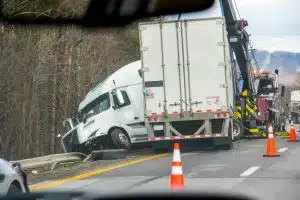 An underride accident happens when a smaller vehicle slides underneath a truck’s trailer. It often shears off the roof and bypasses the car’s airbags and crumple zones entirely. Jackknife truck accidents happen when a truck’s trailer swings out from behind the cab, forming a V-shape that can sweep across multiple lanes of traffic. Both put a passenger vehicle directly in the path of forces it was never built to withstand. Both are responsible for a disproportionate share of the worst injuries and deaths in trucking accidents.
What Causes Underride Accidents and Why Guards Sometimes Fail
Federal regulations have required rear underride guards on trailers since 1998. Those guards are supposed to stop a car’s front end from sliding underneath, so the vehicle’s own crumple zones and airbags can actually do their job. In practice, guards fail often. The Insurance Institute for Highway Safety has found that guards fail in a large share of fatal rear-impact crashes, especially in offset collisions that hit a corner of the trailer instead of the center. Guards also fail when they’re damaged, corroded, poorly maintained, or never installed in the first place. And there’s still no federal requirement for side underride guards at all, which leaves trailers unprotected against the side-impact crashes that kill people every year.
What Causes a Jackknife Accident?
A jackknife happens when a truck’s trailer loses traction and swings out relative to the cab. It’s usually triggered by sudden or hard braking, especially on wet or slick roads. Excessive speed for conditions, mechanical brake problems, an overweight or improperly loaded trailer, and poor braking technique can all contribute. Once a trailer starts to swing, the driver has almost no ability to correct it. The out-of-control trailer can sweep across multiple lanes and hit anything in its path.
Why Do These Crashes Point to Specific Failures Worth Investigating?
Both underride and jackknife accidents tend to have identifiable causes buried in a truck’s maintenance and operational history. An underride crash may point to a missing, damaged, or poorly maintained rear guard, or to a brake failure that caused the truck to stop suddenly. A jackknife may point to worn brakes, an overloaded or unbalanced trailer, or inadequate driver training. Each of those ties back to a specific maintenance record, loading document, or training file. These crashes don’t just happen. They’re usually the end result of a mechanical or regulatory failure that left a paper trail, and paper trails can be found.
How Zarzaur Law Investigates These Crashes
Underride and jackknife accidents involve complex vehicle dynamics, so we bring in accident reconstructionists to determine exactly how the crash unfolded: the truck’s speed, braking, and trailer movement in the moments before impact. That work identifies whether a missing or defective guard, a maintenance failure, or an improperly loaded trailer caused what happened. Reconstruction is often what turns a devastating crash into a clear liability case.
Joe Zarzaur is a Board Certified Civil Trial Lawyer, a credential held by roughly 1% of Florida attorneys, and this firm has taken cases to verdict, including a $50 million jury verdict in 2025 and a $16 million wrongful death verdict in 2023. Trucking cases built on mechanical failure need that trial-tested approach from day one, not just at settlement.
If you or someone you love was injured in an underride or jackknife accident anywhere in Florida, Pensacola, Destin, Miami, or Tallahassee, call now at (855) Hire Joe or reach out via our contact form. We’re ready to investigate exactly what went wrong and hold the responsible party accountable.
Frequently Asked Questions
What is an underride accident?
An underride accident happens when a car or smaller vehicle slides underneath a truck’s trailer, often shearing off the roof and bypassing the vehicle’s airbags and crumple zones entirely.
What is a jackknife accident?
A jackknife accident happens when a truck’s trailer loses traction and swings out from behind the cab, forming a V-shape that can sweep across multiple lanes of traffic. It’s usually triggered by sudden or hard braking.
Can a trucking company be held liable for a failed underride guard?
Yes, in many cases. Federal law has required rear underride guards on trailers since 1998, and a company can be held liable if a guard was missing, damaged, or improperly maintained.
How is fault determined in a jackknife accident?
Fault usually comes down to reconstructing the crash: the truck’s speed and braking, road conditions, and whether the trailer was overloaded or improperly maintained. An accident reconstructionist can pinpoint what caused the trailer to swing.
Why don’t all trailers have side underride guards?
Federal law only requires rear underride guards, not side guards, so trailers remain vulnerable to side-impact underride crashes that a guard could otherwise help prevent.
How common are underride accidents?
Underride crashes make up a meaningful share of fatal collisions between passenger vehicles and large trucks. Researchers believe the real number is even higher, since police crash reports don’t always identify underride as the mechanism of injury.
Are underride accidents usually fatal?
They carry a high fatality risk because the crash bypasses the passenger vehicle’s safety systems, including its airbags and crumple zones, entirely. Even a moderate-speed underride collision can be catastrophic.
What should I do if I’m involved in a jackknife accident?
Get medical attention first. If you’re able, document the scene: photos of the trailer’s position, road conditions, and any skid marks. Get the trucking company’s name and DOT number, and avoid giving a recorded statement before speaking with an attorney.
Who can be held liable in a jackknife truck accident?
Liability can fall on the truck driver, the trucking company, a maintenance contractor, or a cargo loading company, depending on what caused the trailer to swing out of control.