

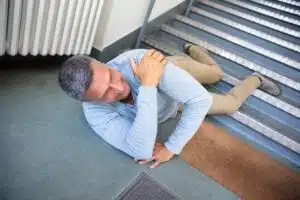
Slip and falls, negligent security, unsafe stairs, and dangerous property conditions — across Escambia and Santa Rosa County.
If you’ve been injured on someone else’s property in Florida in a slip and fall, a swimming pool accident, an attack at an unsecured apartment or parking lot, a fall on broken stairs, or any other unsafe condition, you may be entitled to compensation under Florida premises liability law. Pensacola premises liability lawyer Joe Zarzaur is a Florida Bar Board Certified Civil Trial Lawyer who has obtained record jury verdicts in Escambia and Santa Rosa County for premises injury victims. Call (850) 444-9299 for a free 24/7 case review. There’s no fee unless we win!
At a glance
- Who can be liable: Property owners, managers, business operators, HOAs, condo associations, hotels, landlords, and security contractors.
- Filing deadline: 2 years from the date of injury (FL Stat §95.11, as amended March 2023).
- Florida’s comparative fault rule: Recovery is barred if you are more than 50% at fault (FL Stat §768.81, modified March 2023).
- Damages available: Medical bills, future care, lost wages, pain and suffering, wrongful death.
- Cost to hire us: Contingency fee — you pay nothing unless we recover.
Any person injured in an accident on another person’s property may have a valid legal claim against the owner or manager of the property. Every property owner or manager must take due care and keep their property in a condition that will not cause harm to people who are on the property. If people are injured on another party’s property because of the property owner’s negligence, the victims may have a premises liability claim for financial compensation. Premises liability is a form of negligence, and a claim based on premises liability must be proved by the claimant. If you or a loved one has been injured in an accident on another party’s property, call a Pensacola premises liability lawyer at Zarzaur Law to find out how we can help you.
- Zarzaur Law is a personal injury law firm dedicated to representing victims of another’s wrongdoing in Florida.
- Our practice is completely dedicated to injury and death cases. We are very selective in the cases we take on so that we can focus on quality, not quantity.
- Our Partner, Joe Zarzaur, is a Board Certified Civil Trial Specialist recognized by the Florida Bar and the National Board of Trial Advocacy.
- We have recovered millions in settlements and verdicts for injured victims including record jury verdicts in Escambia County and Santa Rosa County.
If you have been injured in an accident on another person’s property in Florida, our premises liability lawyers can help you understand your rights and get justice from the party that caused your injury. Call us today for a free consultation and review of your case. You can reach us by telephone at (850) 444-9299 or submit our contact form to schedule your free case review by an experienced premises liability attorney.
What is Premises Liability by Law?
Premises liability is a form of negligence that holds property owners or managers responsible for dangerous conditions on their property that cause harm to others on the property. Owners and managers of property have a duty of care to different classes of people that come upon their property. Their duty of care varies depending on what class the visitor to the property fits into. Visitors to a property can either be invitees, licensees, or trespassers.
Duty of Care Owed to Visitors on a Property
An invitee is a person who enters another person’s property for purposes connected with the business of the owner or occupant of the property. For example, when you enter a grocery store to go shopping, you are an invitee on the premises. A property owner’s duty to an invitee is to foresee any possible dangers to the invitee and take reasonable steps to protect the invitee from harm, which they are or should be aware of. Invitees enjoy the highest level of care from property owners or managers.
A licensee is a person who enters another person’s property for their own pleasure or benefit. They could be social visitors to another person’s home or recreation center. A property owner’s duty to a licensee is to refrain from willfully and wantonly injuring the licensee, or intentionally expose them to danger. They must keep their property reasonably safe and warn visitors of any dangers that they are aware of.
A trespasser is a person who is neither a licensee or invitee on the property. A person who is on a property without the knowledge and consent of the owner, and has no legal right to be on the property is a trespasser. Even though the trespasser has no right to be on the property, the property owner still owes the trespasser a duty to not wilfully and wantonly injure the trespasser.
When a property owner fails to meet the duty of care on their property and the visitors are injured, they could be held financially responsible for the victim’s damages.
Have You Suffered an Injury Due to Someone Else’s Negligence? Get Help From a Pensacola Premises Liability Lawyer Today
If you or a loved one has been injured on another person’s property, you may be entitled to financial compensation. Our Florida attorneys can review your case for free to establish your legal position and help you get justice. We offer free consultations and you pay no fees unless we win. Call Zarzaur Law today at (855) Hire Joe or visit our website to schedule your case review.
Be confident you have expert premises liability lawyers on your side.
No Cost, No Fee, Unless We Win
Zarzaur Law is a pure contingency fee law firm. There is NO FEE unless you win. If you don’t collect, we don’t either. Results matter, so make sure to check out our case results as well as our client reviews see what clients have to say about our firm.
Contact our firm today to request a case review or call today at 855hirejoe for your FREE consultation.
Frequently Asked Questions
What is premises liability under Florida law?
Premises liability is a form of negligence law that holds property owners, managers, and occupiers financially responsible for injuries caused by dangerous conditions on their property. Under Florida law, the duty owed depends on the visitor’s status: invitees (customers, business guests) are owed the highest duty, licensees (social guests) a lesser duty, and trespassers the least, although owners still cannot willfully or wantonly injure them. A Pensacola premises liability lawyer can determine which duty applied in your case and whether the property owner breached it.
What does a premises liability lawyer do?
A premises liability lawyer represents people injured on someone else’s property in slip and falls, negligent security incidents, unsafe stairwells, defective elevators, dog attacks, swimming pool accidents, and similar cases, and pursues compensation from the responsible owner, manager, landlord, or business operator. The premises liability attorney investigates the scene, preserves surveillance video and inspection records, identifies every responsible party, retains experts on safety standards and security practices, and either negotiates a settlement or takes the case to trial. In Pensacola, Joe Zarzaur is a Florida Bar Board Certified Civil Trial Lawyer who handles premises injury cases throughout Escambia and Santa Rosa County.
What do I have to prove to win a premises liability case in Florida?
To win a Florida premises liability case, you must prove four elements:
- the property owner owed you a duty of care
- the owner breached that duty
- the breach caused your injury
- you suffered damages.
For business establishments, Florida Statute §768.0755 adds a fifth practical requirement: you must show the business had actual or constructive knowledge of the dangerous condition and should have remedied it. A premises liability lawyer builds this proof through incident reports, inspection logs, surveillance video, prior-similar-incident evidence, and expert testimony.
How long do I have to file a premises liability lawsuit in Florida?
You have 2 years from the date of injury to file most Florida premises liability lawsuits, under Florida Statute §95.11(3) as amended in March 2023. Before that amendment the deadline was 4 years; Florida HB 837 cut it in half. Wrongful death claims also generally carry a 2-year deadline. If a city, county, or state-owned property is involved, additional pre-suit notice requirements apply and the practical deadlines are even shorter. Calling a Pensacola premises liability lawyer early protects evidence and your filing window.
What is Florida’s slip-and-fall law for stores and restaurants?
Under Florida Statute §768.0755, when you slip on a “transitory foreign substance” (a spill, dropped food, water tracked in from outside) inside a business, you must prove the business knew, or should have known, about the substance and failed to address it. You can prove “constructive knowledge” by showing the substance was on the floor long enough that the business should have discovered it, or that the condition occurred regularly and was foreseeable. This is one of the toughest standards in the country, which is why slip-and-fall cases against grocery stores, big-box retailers, and restaurants in Pensacola benefit from an experienced premises liability lawyer who knows how to obtain inspection sweep logs, video, and prior-incident data.
What is Florida’s comparative negligence rule and how does it affect premises liability cases?
Florida uses a “modified comparative negligence” rule: if you are 50% or less at fault, your recovery is reduced by your percentage of fault; if you are more than 50% at fault, you recover nothing. This rule was changed by HB 837 in March 2023; Florida was previously a “pure comparative negligence” state where partially-at-fault plaintiffs could still recover something even at 90% fault. Property owners and insurers now aggressively try to push fault above 50%, which is why an experienced Pensacola premises liability lawyer is essential to defend against unfair fault assignments.
Can I sue an apartment complex, hotel, or business for an attack that happened on the property?
Yes: under Florida’s negligent security law, apartment complexes, hotels, bars, parking garages, and businesses can be held liable when an inadequately secured property allows a foreseeable assault, robbery, or shooting to occur. A negligent security lawyer establishes “foreseeability” through prior crimes on the property, in the immediate area, or in similar businesses, and then proves the owner failed to provide reasonable security — adequate lighting, working locks, security cameras, fencing, or trained personnel. These cases are common around apartment complexes off Davis Highway, downtown Pensacola nightlife venues, and beachfront hotels. Compensation often comes from the property owner’s general liability and umbrella insurance.
Can a trespasser ever sue for an injury on someone else’s property?
Yes, in limited circumstances. Florida property owners cannot willfully or wantonly injure trespassers, and an exception called the “attractive nuisance” doctrine allows child trespassers to recover when an inherently appealing and dangerous condition like a swimming pool, trampoline, or construction site draws them onto the property. In adult trespasser cases, recovery typically requires showing the owner intentionally created a dangerous condition or failed to warn of a known artificial hazard. A premises liability lawyer can evaluate whether any exception applies before assuming a trespass defense ends the case.
What is “attractive nuisance” and when does it apply?
The attractive nuisance doctrine holds Florida property owners liable when a child trespasser is injured by an inherently appealing and dangerous condition the owner failed to secure, most commonly a swimming pool, but also trampolines, abandoned appliances, construction equipment, or unfenced ponds. Courts ask whether the owner knew (or should have known) children might trespass, whether the condition posed an unreasonable risk children couldn’t appreciate, and whether the cost of making it safe was small compared to the danger. Florida’s Residential Swimming Pool Safety Act (FL Stat §515) reflects this doctrine for residential pools by requiring barriers, alarms, or safety covers.
How much does a premises liability lawyer cost?
Most premises liability lawyers, including Zarzaur Law, work on a contingency fee: you pay nothing up front and nothing at all unless we recover money for you. The fee is a percentage of the recovery, agreed to in writing before representation begins, and the firm typically advances case costs (expert witnesses, accident reconstruction, medical records, court fees). If there is no recovery, you owe no attorney’s fee. This means anyone in Pensacola, Pensacola Beach, Perdido Key, Gulf Breeze, or Navarre can hire the experienced team of experienced premises liability lawyers at Zarzaur Law regardless of their financial situation.